
In part one of this blog (HERE), we eavesdropped on a local network meeting that was buzzing with cooperation. But what was really happening, and how can you adapt the partnering examples we witnessed in your network? In part two, we take a closer look. Read on…
Degrees of Partnership
As youth ministry culture has matured, it has become less common for a youth ministry leader to work exclusively "solo." Both locally and nationally, youth leaders believe in networking as vital to their personal health and the advancement of their ministry vision.
Today, doing life and ministry in community with other youth workers is more the norm than the exception. Yet in spite of this wonderful sense of interdependence, youth leaders approach networking with their own expectations, assumptions and motivations.
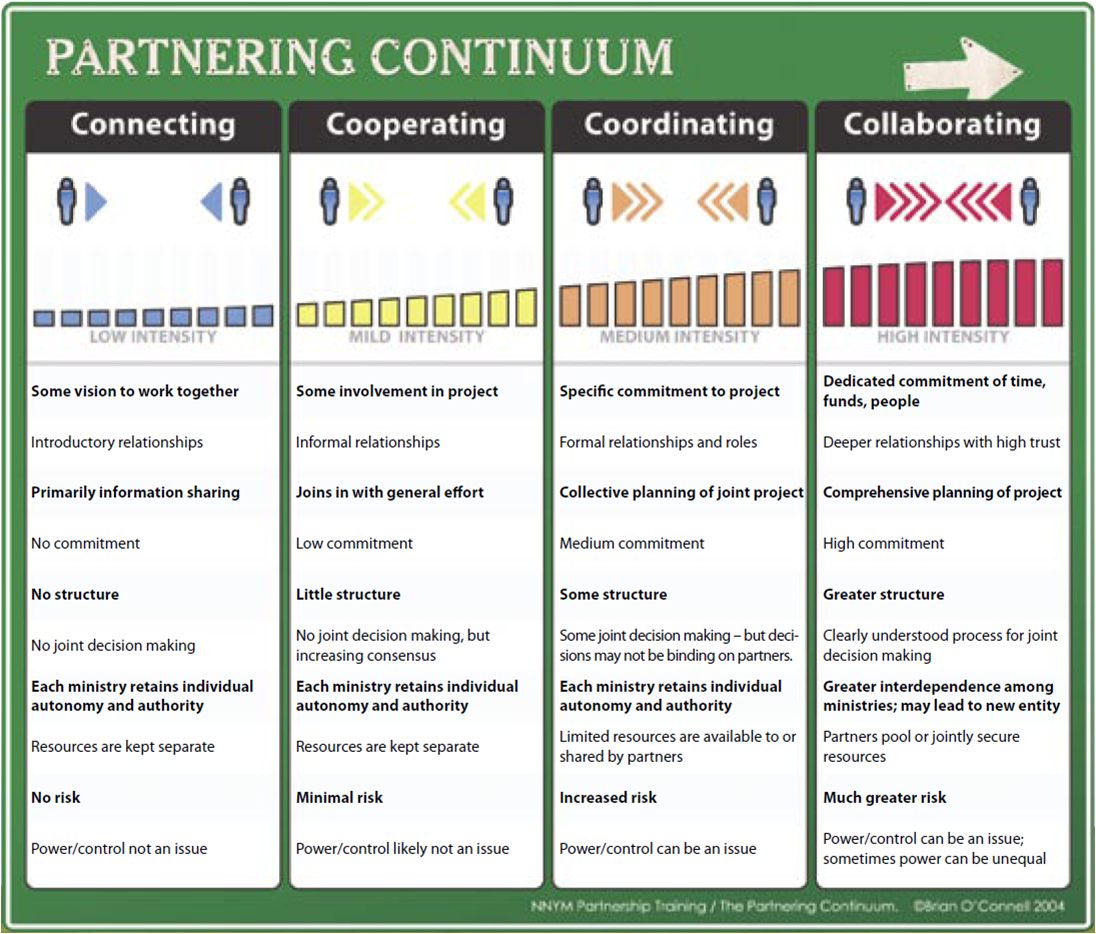
Take a look at look at the Partnering Continuum (graphic created by Brian O'Connell, president of REACT Services) and consider the various types of involvement from Connecting, Cooperating, Coordinating and Collaborating. All of these elements and degrees of commitment are typically present in a healthy local network, as well as in national initiatives (such as See You at the Pole) or coalitions (such as the Campus Alliance). You can click on the image HERE for a closer look.

Networks and Partnerships
All of us have our own networks, both formal and informal. Most ministry networks fall under the "connecting" column, defined as: A group of people who are linked informally and who communicate with one another to share ideas and information to meet their individual needs.
The key activities of a network are introductory relationships and communication. Of course, there are different types of networks, and they can vary greatly in character and complexity. But generally speaking, networks tend to focus on information sharing and relational connections.
In our Christian youth ministry context, networks have provided a place for youth leaders to connect with others who have a common interest, whether it's community-oriented, school- focused, or just to get to know and support each other as fellow workers.
And this brings us to the distinction of the meaning and use of the word "partnership," loosely defined as: A close working relationship between individuals and/or ministries, who agree to work together for a specific purpose because they can achieve more together than by themselves.
Some Networks engage in a fairly low level of partnering. Their members cooperate together, but have little interest in planning ongoing work in a comprehensive manner together. Others engage in a much higher level of partnering, where there is comprehensive planning together for much of their work, and where they pool their resources.
It may be helpful to emphasize that while a local network may not necessarily be a true "partnership," the relationships that are built may result in members of a network moving towards partnering together.
For instance, all the members of a local network may commit to work on a specific project that benefits everyone – where "the entire network" invests time, money and personnel to advance the kingdom of God in a specific area. Recent examples include large area-wide evangelism campaigns, city-wide training events or See You at the Pole rallies.
In other cases, a subset of the network may spin off to cooperate, coordinate or collaborate to accomplish a vision which they share a unique interest in pursuing. It's possible that only three or four youth leaders engage in the work, and thus accept the risk and the reward. Yet, the whole network is the source of their initial connection and stimulates the dreaming of "what could be…"
All or Nothing?
Occasionally youth leaders communicate frustration that their local network doesn't work together more effectively. But even in cases in which the entire network of area churches and youth pastors does not rally behind one project or event, there may still be advances being made through subsets or clusters of youth leaders teaming up for a special effort of common interest.
Even though all members of a network may not fully engage or participate in every event or project, this fact is compelling: Formalized networks are the incubator where partnerships are formed and kingdom efforts advanced.
If you ask enough questions of those involved in healthy collaborative efforts, you soon discover that ongoing partnerships that produce lasting spiritual fruit have typically been birthed and strengthened from within a formal ongoing network.
The bottom line: networks create an environment for community and communication, from which partners can roll up their sleeves and invest themselves in efforts where more is gained together than if each one worked alone. By the way, how many "partnerships" can you spot in the story from Netville USA? How would you describe your network? Where do you see it on the Partnership Continuum?
Make it Personal
You might find it helpful to gather some core leaders of your network (or prospective network) to discuss where your group is on the Partnership Continuum. It may well lead to ways you can collaborate for greater effectiveness.
Have your leaders read through this article online or print the PDF version. Then after reading it, come together to discuss these questions.
- Ask them to consider the following questions, and then discuss it together:
- Where would they put your network on the Continuum? Why?
- What examples have you seen as you've worked together that have led to the "Collaboration" side of the line?
- What impact did they have on kingdom growth in your community?
- What barriers do you see that make greater cooperation difficult (e.g., history of conflict between ministries or key leaders, denominational or doctrinal issues, nobody has ever talked about it before, etc.)?
- What are some measurable steps your group might take to advance a climate of cooperation, and possibly see collaboration happen more organically in your ministry community?
Doug Tegner is the Pastor of Discipleship and Mission at Redwood Chapel Community Church in Castro Valley, CA. Follow him on Twitter @dteg.